Understand the request
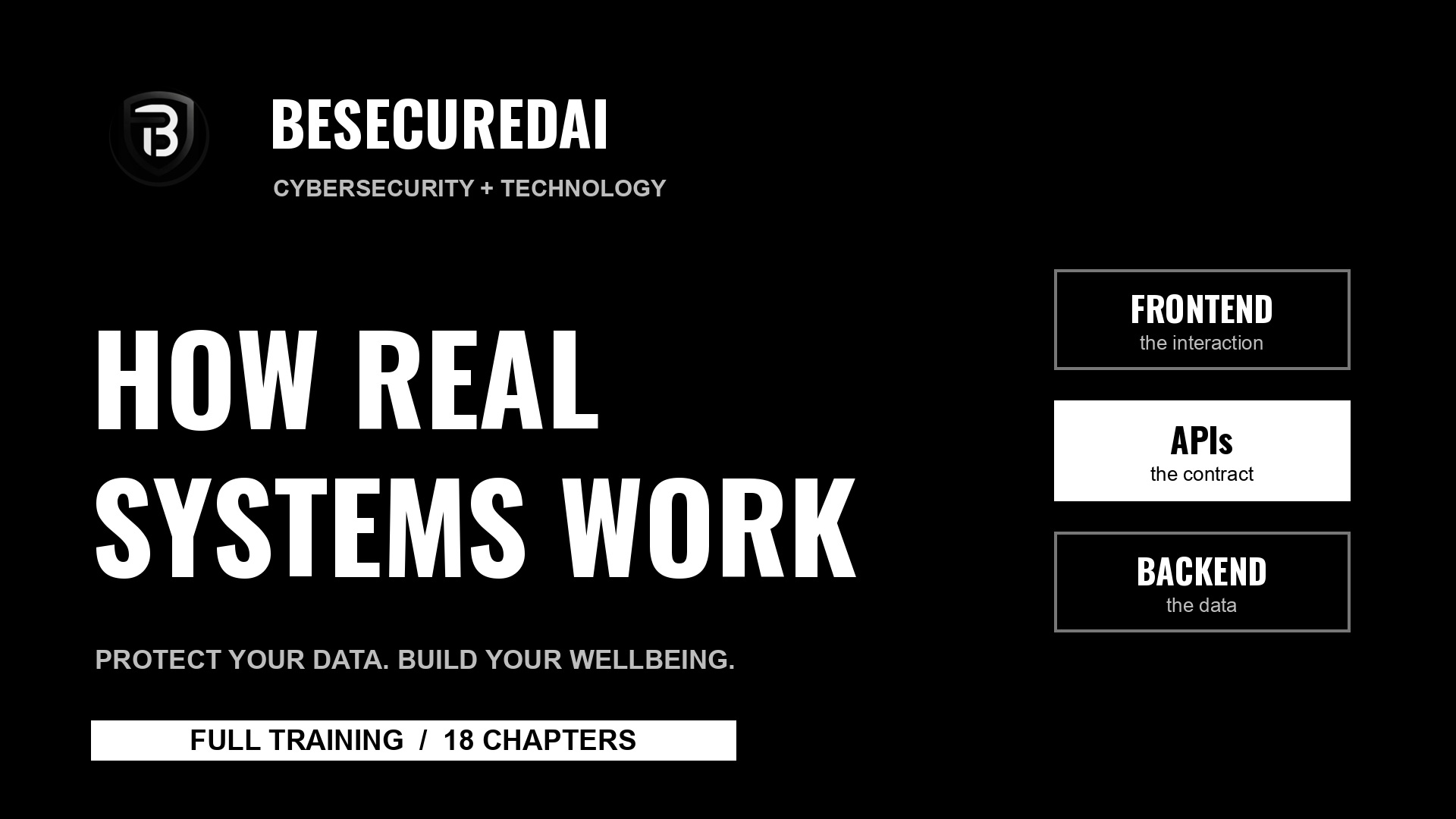
Trace the frontend, APIs, services and data. Learn why retries need safeguards, why cached data needs boundaries and why each service must check permissions.
 BESECUREDAI
THE VIDEO LIBRARY
One full training, a quick overview and three focused lessons. Choose a starting point, then put one idea to work.
Videos open on YouTube. No embedded YouTube player, remote thumbnail or tracking script loads here. The training uses AI narration.
FULL TRAINING · 18 CHAPTERS · 26:56
Follow one customer’s tap on Buy through an imaginary neighborhood shop. See how the frontend, APIs, databases, cloud services and payment systems work together, and where access checks, backups and review matter.
18 chapters · English captions · Original explanatory diagrams. Educational training, not a security certification. The video opens on YouTube.
A PRACTICAL WAY TO LEARN
You do not need to memorize every tool name. Follow the path from a person’s request to stored data, then check who can act, what can fail and how recovery works.
Trace the frontend, APIs, services and data. Learn why retries need safeguards, why cached data needs boundaries and why each service must check permissions.
Compare password defenses, safer SQL queries and delegated access. Separate OAuth permissions from sign-in, and keep AI tools within approved data and action limits.
Distinguish payment approval from settlement. Review notifications, backups, tests and release gates. Historical company examples illustrate trade-offs; they are not a current infrastructure audit.
Each link opens the full training on YouTube at the listed chapter.
Topic inspiration: ByteByteGo’s system-design material. The explanations and diagrams in this training are original. No endorsement is implied.
Have a few minutes? Start with the 2:31 overview, then choose a short lesson. Each one links to a practical security check.
2:31 OVERVIEW
A concise security-first map of everyday applications: APIs, password defenses, parameterized queries, OAuth versus OpenID Connect, limited tokens and specific checks at trust boundaries.
Read the full security baselineSHORT LESSON
Six common ways attackers target account access, and why authentication, recovery, device protection and monitoring belong together. Layered controls reduce risk; no stack guarantees every attack will fail.
Check account securitySHORT LESSON
Follow one illustrative app request through frontend, APIs and data services, then ask what each trust boundary must check. Real architectures and timings vary.
Read the website security baselineSHORT LESSON
Authorization, clearing and settlement are different parts of a card payment. Refunds, reversals and chargebacks can still create obligations after settlement. This is a simplified educational model, not payment-provider or legal advice.
Review payment safeguardsVideos open on YouTube. No YouTube player or remote media loads on this page.
AFTER YOU WATCH
Use an application you own or are authorized to administer. Keep passwords, recovery codes and private customer records out of your notes.
Pick a familiar action, such as placing an order. Write down the screen, service and stored records involved.
Identify who can read or change each record. Note where a payment, account change or AI action needs an authorized review.
Ask what happens if a request repeats, a service stops or an account is lost. Verify a backup by restoring a harmless sample.
Record one gap, the person responsible and how you will verify the fix. Return to the self-check when the change is complete.